Buyer's Guide
Carpentry Deposit Structure Singapore — How Payments Should Be Staged
What a reasonable carpentry deposit looks like in Singapore — and which payment structures should make you walk away from a quote.
19 May 2026 · 6 min read · Updated 19 May 2026
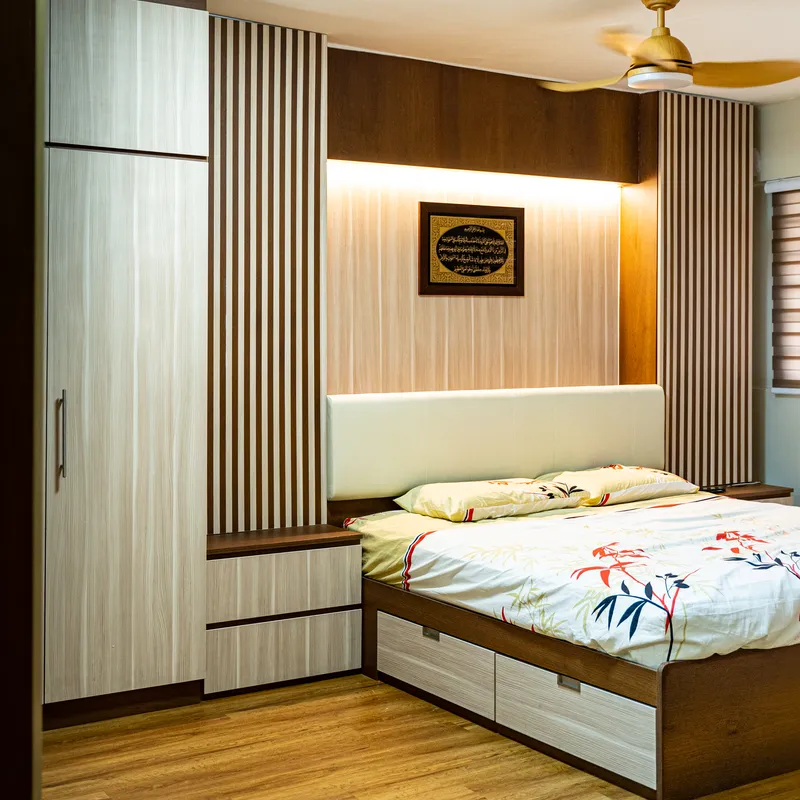
Kitchen cabinetry under construction at workshop — TOKTOKTOK Carpentry Singapore
The deposit conversation is where good Singapore carpenters separate themselves from the scams and the cowboys. A reasonable deposit structure protects both sides; a bad one transfers all the risk to you and is the single most common warning sign of a contractor that won't finish the job.
This guide explains what's normal, what's reasonable to negotiate, and what should make you walk away.
What's standard in Singapore
The market-standard carpentry deposit structure looks like this:
- 50% deposit on confirmation of design and 3D mock-up sign-off
- 50% balance on completion of installation and handover
Some workshops split the balance further (10% on delivery, 40% on handover) — that's fine. The key principle is that you should never pay more than half upfront, and the second payment should be tied to a deliverable you can verify (completed installation, signed handover document).
Why 50% upfront is reasonable
A 50% deposit covers the carpenter's material cost on most jobs. Carcass plywood, laminate, hardware, edge banding — these are paid for upfront by the workshop to their suppliers, before fabrication begins. If you paid less than ~40% upfront, the carpenter is funding your materials out of pocket, which only works if they have substantial reserves (most don't).
50% is enough to start work confidently. 50% is also enough to make the workshop care about finishing — they're already half-paid, so abandoning your project means losing their margin and the second 50%.
Below 30% upfront, even reputable carpenters often say no — too much risk on their side.
Above 60% upfront, the risk shifts heavily to you. The carpenter has limited downside if they don't finish.
Red flags in deposit structures
Walk away from any of these:
"100% upfront, discount for cash"
This is the scam pattern. The "discount" is the bait, the cash is the get-away vehicle. Once paid, the carpenter has every incentive to either disappear or to deliver minimum-effort work. No legitimate Singapore workshop operates this way.
"Cash only, to a personal account"
A registered business in Singapore (sole proprietor, Pte Ltd) has a corporate bank account and issues invoices. Cash-to-personal-account is a sign of either tax avoidance (their problem) or that the "business" isn't registered (your problem — no recourse if disputes arise).
Always pay to a registered company account, against an issued invoice.
"70% deposit because materials are expensive right now"
This is the supplier-cost excuse, sometimes legitimate, mostly not. The genuine answer to high material costs is to quote a higher total, not to shift more of the payment forward. If a workshop is consistently asking for 70%+ upfront, they have a cash-flow problem, which means your job is competing with their other obligations.
A one-off ask for 60% with a clear reason (e.g. an imported specialty material with non-refundable supplier deposit) is reasonable. A standard 70% across all jobs is not.
Multiple "deposits" before fabrication starts
Some quotes split the upfront into "design fee," "measurement fee," "fabrication start fee" — three payments before any wood is cut. This obscures how much you're actually paying upfront. Add them all up. If the total before fabrication exceeds 50% of the project total, push back.
No written invoice or receipt
Every payment should generate an invoice (issued by the workshop, listing the work and amount) and a receipt (confirming you paid). If a workshop refuses to issue these, walk away — both for tax reasons (your problem if audited) and for dispute reasons (no paper trail = no recourse).
What reasonable carpenters say
When a carpenter explains their deposit, you should hear something like:
"50% on confirmation of design after the 3D mock-up. We use that to buy materials and start fabrication. Balance 50% on completion when you've walked through and confirmed everything works. Both payments by bank transfer to our registered company account, and you'll get an invoice for each."
That's the script. Variations are fine. The shape — half upfront against design, half on completion against verification, to a company account with paper — is the test.
What about progress payments on bigger jobs?
For larger projects (full-flat condo, landed homes) running into S$30,000+, some workshops offer or accept three-stage payments:
- 30% deposit on design confirmation
- 30% on fabrication completion (before delivery)
- 40% on installation completion
This splits your risk into three smaller chunks. It's slightly more administrative for both sides but reasonable. Some customers prefer it for cash-flow reasons; some workshops prefer it because the middle payment funds the next phase. If your project is over S$30,000 and you want three-stage, it's worth asking.
How to protect yourself further
A few small habits that take five minutes each and save real money if anything goes wrong:
-
Save the company UEN. Every Singapore registered business has a UEN (Unique Entity Number). Look it up on https://www.bizfile.gov.sg/ngbbizfileinternet — confirms the company is active and gives you the registered address. Free.
-
Pay in a way that leaves a record. PayNow to the company UEN or bank transfer to a corporate account. Both create timestamped, traceable records. Avoid cash for anything over S$500.
-
Get the deposit terms in the quote, not just verbally. "Deposit: 50% on 3D mock-up sign-off, balance on completion" should appear on the written quote. If a verbal agreement is followed by a different written quote, the written version is what counts.
-
Don't pay until 3D is approved. Some workshops ask for a deposit before 3D drawings are produced. Push back. The 3D is part of what the deposit pays for; without it, you're paying before you've seen what you're getting.
-
Hold back the final 10% as a quality-check buffer if you can. This isn't standard practice in Singapore (workshops generally expect full balance on completion), but for larger projects some workshops will agree to a 90-on-completion, 10-after-30-days structure. Worth asking on bigger jobs.
What TOKTOKTOK does
For full transparency: we run the standard structure.
- 50% deposit when you've signed off on the 3D mock-up. Paid by bank transfer or PayNow to our registered company account; invoice issued same day.
- 50% balance on completion of installation, after you've walked through every piece and confirmed quality. Final invoice + receipt issued at handover.
- No cash payments, no personal accounts, no exceptions.
- Three-stage payments available for projects over S$30,000 if you'd prefer.
For very large landed projects (S$50,000+) with imported materials, we sometimes ask for an additional non-refundable specialty-material deposit before fabrication — this covers items like imported brass hardware or veneer that we'd have no other use for if the job changes. That deposit is always called out separately on the quote, with the specific material it covers, so you know what it's for.
Where to go from here
If you're reviewing quotes right now and want a second pair of eyes on the deposit structure, send screenshots or photos of the relevant section on WhatsApp. No charge, no pitch — we'll just tell you whether what you're being shown is normal.
For broader context on what a fair quote looks like end-to-end, see the HDB kitchen cabinet cost guide or the pricing page for indicative ranges.
Ready to build?
Get a real quote for your project.
Share your floor plan and a few reference photos. Real quote in writing within 24 hours, no commitment.