Decision Guide
Interior Designer vs Direct Carpenter in Singapore — When Each Wins
When an interior designer is worth the coordination fee and when going direct to a carpenter saves you 10–20% with no loss in quality.
19 May 2026 · 8 min read · Updated 19 May 2026
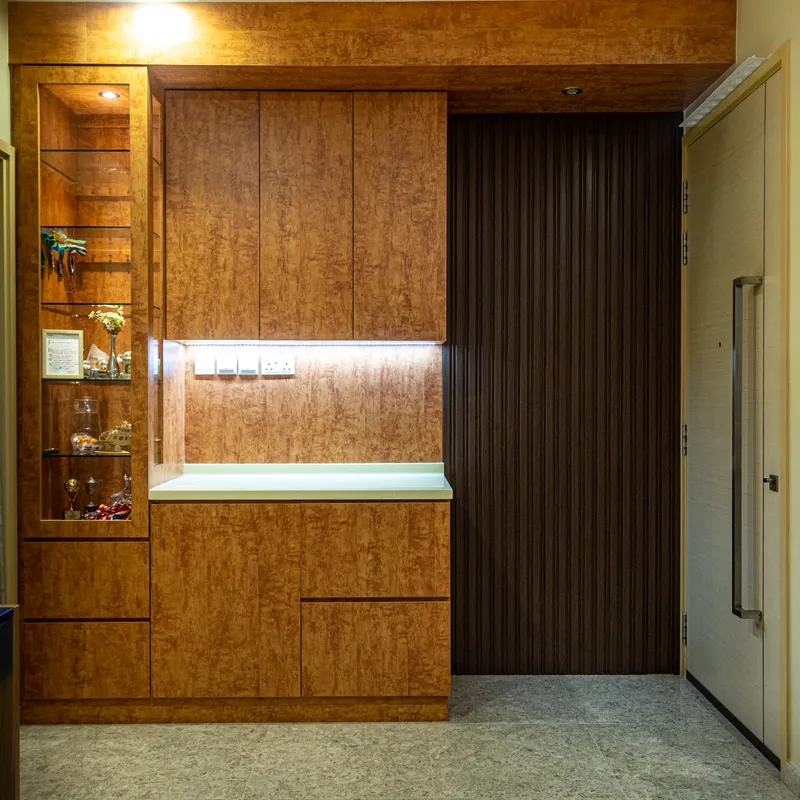
Open-plan kitchen with island in a Compassvale condo — TOKTOKTOK Carpentry Singapore
Every Singapore homeowner starting a renovation hits this fork: hire an interior designer (one firm coordinates every trade for a fee) or go direct to trades (you contract each specialist yourself — carpenter, flooring, electrician, painter — and coordinate). The decision affects budget by 10–20% and stress level by considerably more. This guide explains when each route wins, with real numbers.
What an interior designer actually does
An interior designer (ID) in Singapore is rarely just designing. They're project-managing your renovation end-to-end:
- Design: 3D mock-ups, layout, material palette, lighting plan
- Trade sourcing: the ID picks the carpenter, flooring contractor, painter, electrician, tile layer
- Coordination: sequences each trade so they don't trip over each other on site
- Quality control: checks each trade's work, escalates issues
- Single point of contact: you talk to one person; they talk to ten
In return, the ID charges either a percentage of the renovation budget (typically 10–20%) or a fixed coordination fee plus a markup on every trade's quote (usually 10–15% on each line item).
For a S$60,000 renovation, the ID fee runs S$6,000–S$12,000 depending on the firm and how they price.
What going direct means
Going direct means you are the project manager. You:
- Source each trade yourself (carpenter, flooring contractor, electrician, etc.)
- Get quotes from each, negotiate each
- Sequence them on site (carpenter measures after flooring, electrician runs wiring before painting, etc.)
- Resolve disputes when one trade's work affects another's
- Pay each separately
You skip the ID fee. For the same S$60,000 scope, you pay S$50,000–S$55,000.
The trade-off: you spend somewhere between 20 and 80 hours managing the project yourself, depending on your style and the project's complexity.
The honest decision matrix
There are four variables that decide which route wins:
1. How much time you can give the project
If you can give 5–10 hours a week for 3–4 months, going direct works. If you can give 1–2 hours a week, hire an ID — the project will run badly without active management, and ID coordination becomes worth its fee.
Worst case for direct: mid-career professionals with demanding day jobs and travel. The renovation slips week after week because no one is actively pushing.
Worst case for ID: detail-oriented owners who'll re-design every decision the ID makes anyway. You'll pay coordination fees and still do the work — that's the worst of both.
2. How much your money buys per hour
If your hourly rate at work is S$80+, every hour of renovation management is opportunity cost. At 30 hours of management over the project, you've "spent" S$2,400 of your time. The ID fee at 10% on a S$60k renovation is S$6,000 — so direct saves S$3,600 net of time cost.
If your hourly rate is S$30, the same calculation says ID is barely break-even; direct clearly wins.
This is the calculation most homeowners forget. Run it before deciding.
3. How much you trust your own taste
ID-led projects tend to look more "designed" — a coherent material palette, a thought-through lighting plan, a clear visual direction. Direct projects look like the owner's accumulated decisions, which is sometimes great (clear personal style) and sometimes muddled (compromises accumulate).
If you walk through your current home and dislike half of what you chose, an ID is worth the money. If you walk through and feel "yes, this is me" — go direct.
4. How specific your priorities are
If you have two or three strong priorities (great kitchen, walk-in wardrobe, no decorative excess) and a clear budget — direct works well. You can spec those two or three things tightly with the carpenter and let everything else be functional.
If you want everything to feel cohesive and considered — bathroom soap dispensers matching cabinet handles matching door hardware — an ID delivers that better.
What a direct route looks like in practice
If you decide to go direct, here's the sequence we see work:
- Lock the carpenter first. Carpentry is 30–40% of most renovations and has the longest workshop lead time. Get the carpentry quote, secure a fabrication slot, then everything else slots around it.
- Get three trade quotes per scope — flooring, painting, electrical, tiling. Compare line items, not just totals.
- Sequence on paper before starting. Write out which trade goes when, in what order. Most disputes come from sequence violations (painter shows up before electrician finishes).
- WhatsApp groups for each phase. Don't try to coordinate trades over email. A WhatsApp group with the active trades for the current phase is the lowest-friction tool.
- Site visits weekly. Direct routes need owner presence on site at least once a week to catch issues before they cascade.
We do this with direct-route customers regularly — about half our HDB jobs are direct (no ID involved), the other half go through IDs who engage us for carpentry only.
What an ID-led route looks like in practice
If you go ID:
- Interview three IDs before signing. Their portfolios should look like things you'd actually live in, not magazine glamour shots.
- Ask how they pick trades. A good ID has a stable of trusted carpenters, electricians, etc. they've worked with for years. A bad ID picks based on whoever is cheapest this month.
- Get the contract in writing with scope and milestones. Avoid open-ended "design fee" arrangements without clear deliverables.
- Watch for trade markup. Some IDs add 10–15% on each trade's quote — invisible to you, but it's where their real margin is. Ask explicitly: "Do you take a markup on trade quotes?"
- Maintain direct relationships with trades anyway. If the ID disappears or under-performs, you want to know who the carpenter is so the work doesn't stall.
The best IDs deliver the design + coordination value clearly and don't hide pricing. The worst pad every trade quote and disappear after the deposit.
When IDs definitively win
There are situations where ID is the right call even at your high hourly rate:
- First-time renovation. You don't know what you don't know. The ID fee is education + safety net.
- Tight timeline. Move-in date is locked, no buffer. You need someone whose full-time job is making sure the schedule holds.
- Heavy structural changes. Hacking walls, repositioning bathrooms, opening up the kitchen. ID coordination is worth the fee here.
- High-end finish complexity. Multiple imported materials, custom upholstery, integrated AV — the coordination load is genuinely heavy.
- You hate disagreeing with tradespeople. Direct routes require pushing back on quotes, on quality, on timing. If that's not a skill you want to develop, ID is worth it.
When direct definitively wins
- You've renovated before and know the rhythm.
- Single-scope projects — just kitchen, or just wardrobes. ID coordination is overkill.
- You have a strong existing personal style and a few clear priorities.
- Your renovation budget is under S$40,000. ID fees are a bigger proportional bite below this; direct math gets meaningfully better.
- You're comfortable on WhatsApp with multiple trades simultaneously.
A middle path
There's a third option that splits the trade-off: engage an ID for design only, contract the trades yourself.
You pay the ID a fixed design fee (typically S$2,000–S$5,000) to produce 3D mock-ups, material palette, and a lighting plan. You then take that pack and engage trades directly using the ID's spec as your reference. No coordination fee, no trade markup, but you keep the design value.
This works when you trust your own coordination ability but want professional design input. About one in ten direct customers we work with come this way.
How carpentry fits into the decision
Carpentry is the single biggest line item in most renovations and the highest-stakes for material quality and workmanship. Two things to know:
- A good carpenter can work direct or through an ID equally well. We do both regularly. The work is the same; the invoicing path is different.
- The carpenter's quote should be transparent regardless. Materials by name, hardware by part number, dimensions in writing. If an ID is hiding the carpenter's quote behind a "package price," ask to see the carpentry breakdown.
Where to go from here
If you're at the decision point: WhatsApp us with where you are in the process and we'll tell you honestly which route makes more sense. We work both ways, so there's no pitch.
WhatsApp Alan with your project context.
For pricing context, the HDB 4-room renovation cost breakdown shows trade-by-trade numbers including the ID coordination fee line. For the carpentry-specific pricing, see the pricing page.
Ready to build?
Get a real quote for your project.
Share your floor plan and a few reference photos. Real quote in writing within 24 hours, no commitment.