Materials
Choosing Laminate for Kitchen Cabinets in Singapore's Humidity
Why material choice matters more in Singapore — and which laminates are actually worth speccing for kitchen cabinets.
20 April 2026 · 5 min read · Updated 18 May 2026
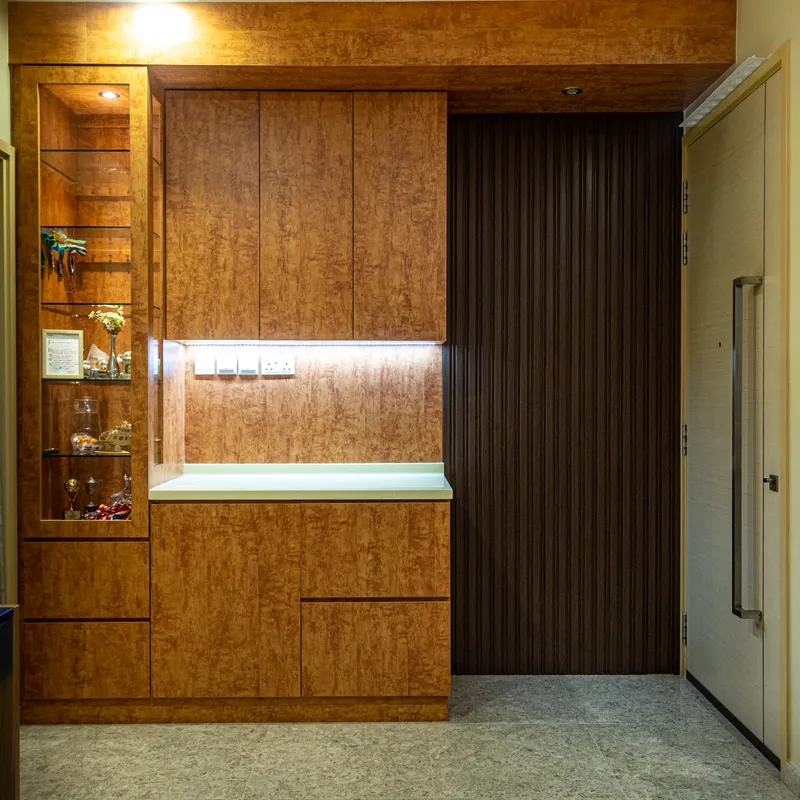
Clean-line kitchen cabinetry laminate detail, Compassvale condo — TOKTOKTOK Carpentry Singapore
Singapore's climate is unforgiving on kitchen cabinetry. Steady 70–85% humidity, frequent cooking steam, wet kitchen floors during cleaning — all of it conspires to delaminate, swell, or warp finishes that would be fine in a drier climate. Here's what to spec, and what to avoid.
What actually fails in a Singapore kitchen
Three modes of failure, in rough order of frequency:
- Board swelling. Untreated chipboard or cheap MDF absorbs humidity and expands — doors stop closing flush, edges lift, and the cabinet box itself distorts. Almost always caused by skipping moisture-resistant substrate.
- Edge delamination. Laminate peeling from the edge of a door or shelf. Happens where water seeps in through a poorly-sealed edgeband — typically near sinks or dishwashers.
- Finish discolouration. Cheap melamine fades or yellows near the hob and sink. Real HPL and PET rarely have this problem.
Addressing these is about picking the right substrate and the right surface finish. Most homeowners focus on the finish and forget the substrate — that's backwards.
Start with the substrate
For kitchen carcasses in Singapore, the default should be moisture-resistant (MR) plywood — often called "marine ply" colloquially, though true marine-grade is overkill for indoor cabinets. Standard MR ply is what you want.
Avoid:
- Raw chipboard or MDF for kitchen carcasses. It will swell within a few years in a Singapore kitchen.
- Cheap "moisture-resistant particleboard" without a clear spec. If your carpenter can't tell you the grade, assume it's not good enough.
When we quote kitchens, MR ply carcass is the default — not an upgrade. It should be in yours too.
Then the door finish
Four common options, ranked roughly by durability and cost:
1. HPL (High-Pressure Laminate)
The workhorse of Singapore kitchens. Pressure-cured sheets bonded to a ply or MDF door blank. Highly resistant to water, heat, and impact. Available in hundreds of patterns and colours.
Singapore suppliers to ask for by name: Lamitak, EDL, Greenlam, Polyrey, Formica. Ask your carpenter which book they're quoting from.
Good for: everyday HDB and condo kitchens. 8–15 year lifespan without visible wear.
2. PET (Polyethylene Terephthalate)
A thin thermoplastic film laminated to the door. Smoother and more fingerprint-resistant than HPL. Slightly pricier.
Good for: handleless kitchens where fingerprints on doors would be visible. Modern matte looks.
3. Acrylic or gloss laminate
High-gloss mirror-finish fronts. Striking visually but show every scratch and every fingerprint. Not typically recommended for working kitchens unless you accept the maintenance.
4. Veneer or solid wood
Real wood on door fronts gives a premium look. More expensive, and requires sealing to handle kitchen humidity. Works well in dry kitchens (less cooking, mostly a "showpiece" kitchen). Avoid near the hob unless sealed with a kitchen-grade topcoat.
Edging matters more than you think
Laminate is only as good as its edgebanding. Cheap PVC edge tape peels within a year. The better options:
- ABS edgebanding, heat-fused to the panel — the current Singapore standard for quality carpentry.
- Laser-edge finishing — a seamless fuse that's nearly invisible and highly water-resistant. Available on higher-end builds.
Ask your carpenter explicitly: "What edgebanding is used, and how is it fused?" If the answer is "PVC tape" or "standard" — push for ABS at minimum.
Common Singapore pairings
What we most often spec for HDB and condo kitchens:
- Budget-friendly but solid: MR ply carcass + HPL fronts (Lamitak or EDL) + ABS edgebanding + Blum soft-close. Lasts 10+ years.
- Mid-range: MR ply + PET fronts + laser edging + Blum Tandembox drawers. The current sweet spot for matte, handleless looks.
- Premium: MR ply + veneer or solid wood upper accents + HPL lowers (for durability near water) + full Blum hardware. Best of looks and longevity.
The shortlist
If you remember nothing else from this post:
- Demand moisture-resistant ply carcass. No shortcuts here.
- Choose HPL or PET as default; reserve veneer for dry areas.
- Ask which laminate brand and which edgeband — by name.
- Don't pay extra for "premium soft-close" — Blum/Hettich soft-close should be included.
Want us to quote it?
Send your floorplan, your preferred look (photos help), and whether you want MR ply or a step above — we'll come back with a spec and a number. WhatsApp us or use the contact form.
For the structural side of the same conversation — what's actually inside the cabinet box — read the plywood vs blockboard vs MDF guide. For pricing context, see the kitchen cost guide or the pricing page.
Ready to build?
Get a real quote for your project.
Share your floor plan and a few reference photos. Real quote in writing within 24 hours, no commitment.