Guide
Sliding vs Swing Wardrobe Doors: Which Is Right for Your HDB?
The decision that changes your bedroom more than any other carpentry choice. A practical framework for HDB and condo rooms.
19 April 2026 · 4 min read · Updated 18 May 2026
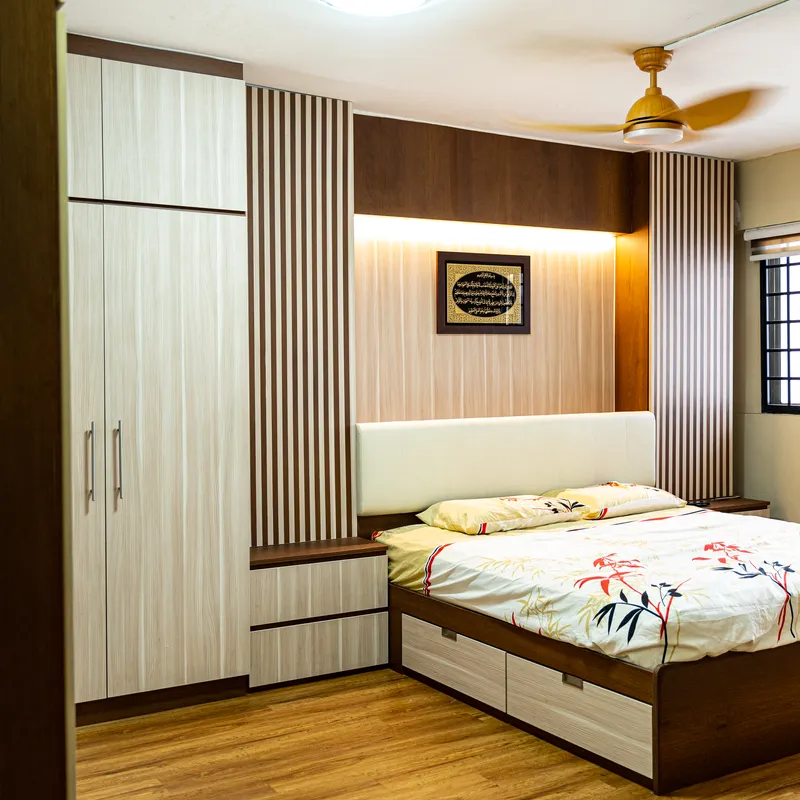
Built-in wardrobe in Hougang HDB with warm timber tones — TOKTOKTOK Carpentry Singapore
The single biggest wardrobe decision isn't the finish or the colour — it's the door style. Sliding or swing? The wrong choice wastes either your floor area or your view of your own wardrobe. Here's how to decide.
Sliding doors
Two or three panels that slide horizontally on a track. The classic modern HDB master-bedroom look.
Pros
- Zero clearance required. Sliders don't swing out, so you can place the wardrobe directly opposite a bed or wall without giving up any floor space.
- Visual lightness. Large panels read as one continuous surface, especially with full-height mirror panels.
- Better for tight rooms. Typical 3-room HDB master bedrooms or condo rooms under 3m wide work much better with sliders.
Cons
- You see half the wardrobe at a time. When one door is open, the other half is hidden. Makes grabbing items from two zones inconvenient.
- Track hardware matters. Cheap tracks rattle, derail, or wear in 2–3 years. Quality hardware (Hafele, Hettich) is worth the upcharge.
- Harder to service. Adjusting a sliding track requires lifting panels out — not a DIY job.
Swing doors
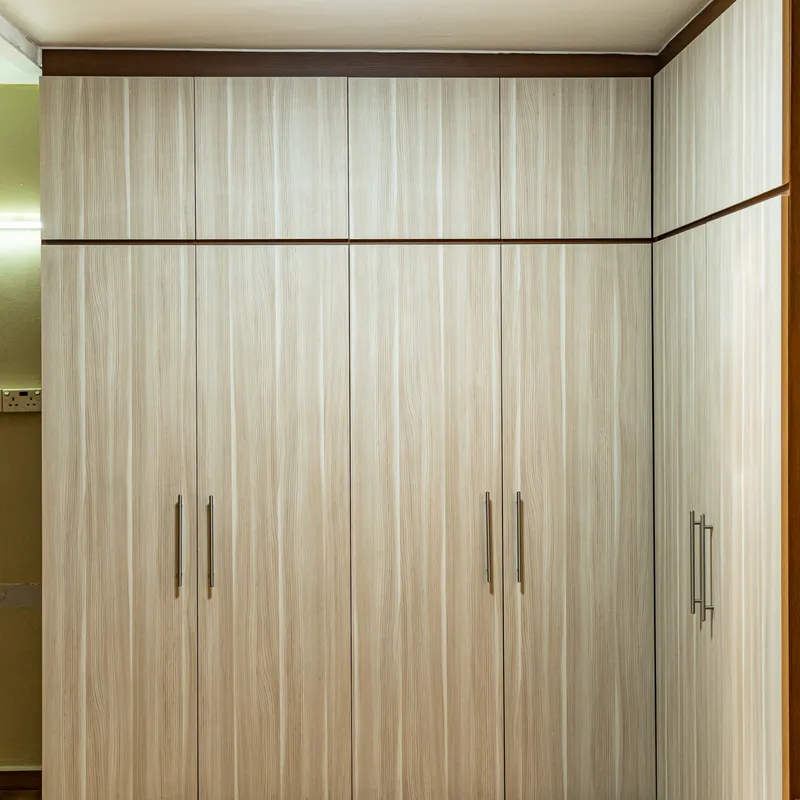
Hinged doors that open outward, like kitchen cabinet doors. The classic built-in wardrobe style.
Pros
- You see everything. Open both doors and the whole wardrobe is visible at once. Way better for quick access.
- Simpler, more durable hardware. Soft-close hinges (Blum, Hettich) last 15+ years with no maintenance.
- More flexible interior. You can mount accessories like tie racks, belt pulls, and mirrors on the inside of the door.
Cons
- Needs clearance. A swing door typically needs 55–60cm of clear floor space to open fully. In a tight HDB master bedroom, that often means the door clips the bed.
- Can feel boxier. Multiple doors with vertical seams break up the wall visually, whereas sliders read as one surface.
A quick decision framework
Step through these in order:
- Measure the floor space between the wardrobe wall and the nearest obstacle (bed, opposite wall). If it's under 70cm, default to sliders.
- Count how many sliding panels you'd need. For wardrobes wider than 3m, you need three or more panels — and three-panel systems are fussier than two-panel. At three panels, reconsider swing.
- Consider access patterns. If you habitually reach into the wardrobe multiple times in the same morning (work clothes, then gym, then something else), swing is more convenient.
- Check your ceiling height. Sliding panels look best full-height in BTO flats (2.6–2.8m). In a condo with 3m+ ceilings, sliding can feel stretched — swing with a separate top-up cabinet usually looks better.
Hybrid setups
You don't have to pick one. Common in larger HDB and condo masters: a combination where the main hanging section has sliding doors (against the bed-facing wall) and a secondary compartment near the door has swing doors for daily-access items like bags and belts. Best of both, slightly higher cost.
What we recommend most often in Singapore
For 3-room and 4-room HDB masters: sliders almost always, because the floor plan is tight.
For 5-room HDB and condo masters: depends on the width — sliders for under 3m, swing for 3m+ unless the owner really wants the cleaner look of sliders.
For walk-in wardrobes: swing doors throughout. You have the space, and access matters more than floor clearance.
Still unsure?
Send your floorplan and a photo of the bedroom on WhatsApp. We'll measure on site and propose the layout that fits your room, not a template — free quote within a day or two.
For the broader context, see our built-in wardrobes service page for what's included, the pricing page for indicative ranges, or the plywood vs blockboard vs MDF guide for what's actually inside the wardrobe carcass.
Ready to build?
Get a real quote for your project.
Share your floor plan and a few reference photos. Real quote in writing within 24 hours, no commitment.